Articles 26 min read

Light Up Paper Cut Shadow Box Safely with LED Lights

Your comprehensive guide to light up paper cut shadow box.

Light Up Paper Cut Shadow Box Safely with LED Lights

Light Up Paper Cut Shadow Box Safely with LED Lights

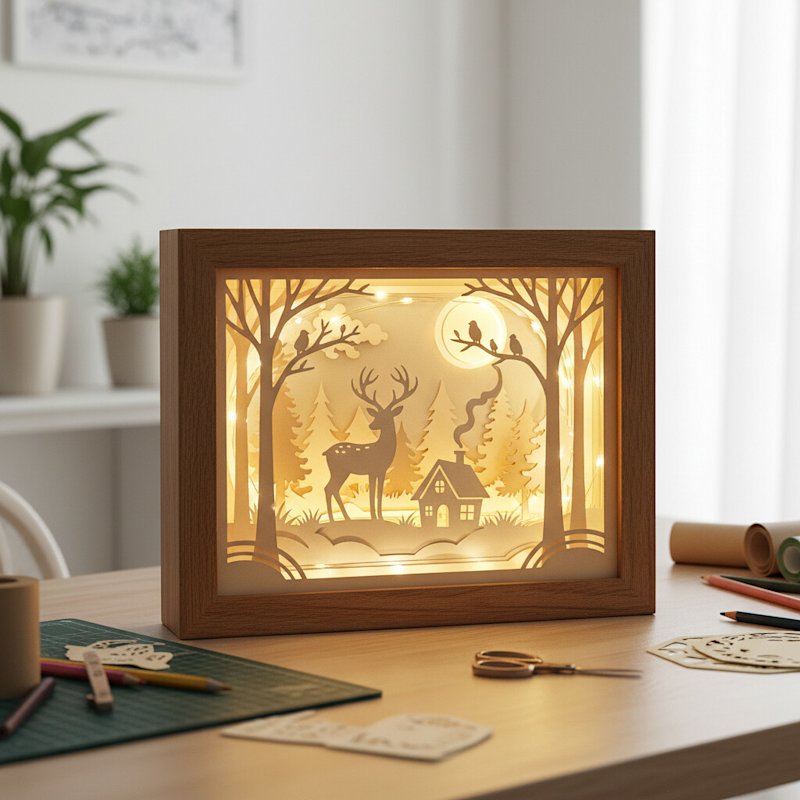
When you light up paper cut shadow box displays, you transform beautiful craft projects into enchanting illuminated art that glows with warmth and magic. Adding LED fairy lights to your paper cut shadow box creates stunning visual effects, but safety must be your top priority when working with paper materials and electrical components. In our complete shadow box guide, we introduced lighting basics. This guide dives deep into choosing the safest LED lights, understanding heat risks with paper, and installing your lighting correctly to create a stunning shadow box that's both beautiful and safe.

Whether you're creating your first light-up paper cut shadow box or adding lights to an existing project, understanding the differences between LED strips and fairy lights, heat considerations for cardstock, and proper installation techniques ensures your shadow box shines safely for years to come.

Understanding LED Safety with Paper Materials

Why LEDs Are Safe for Paper Projects

LED (Light Emitting Diode) technology revolutionized craft lighting because LEDs operate at dramatically lower temperatures than traditional incandescent bulbs. While old-fashioned Christmas lights could reach temperatures hot enough to scorch paper or fabric, LEDs remain cool to the touch even after hours of continuous operation.

The science behind LED coolness: LEDs produce light through electroluminescence rather than heating a filament. This means they convert electrical energy directly into light with minimal heat generation. Quality LED lights designed for crafts typically operate at temperatures between 80-100°F (27-38°C), well below the ignition temperature of paper, which is approximately 451°F (233°C).

Battery-operated LED lights for crafts produce essentially no heat, even when left on 24/7. This prevents any risk of delicate paper artwork being damaged from heat buildup, making them ideal for shadow box projects with multiple cardstock layers.

Heat dissipation: The small amount of heat LEDs do generate concentrates at the base of the LED bulb, not at the light-emitting surface. In LED strips, this heat dissipates along the backing strip. In fairy lights, the tiny bulbs distribute heat across many individual points, preventing dangerous temperature concentration.

Paper and Cardboard Fire Safety Facts

While LEDs are extremely safe, it's important to understand the actual risks when combining any electrical component with paper materials.

Real-world fire risk: LED fairy lights and strips are not generally fire hazards because they don't use much energy and don't produce significant heat. However, basic safety practices still apply to any electrical device in your home.

What could cause problems: The primary risks with LED lights and paper aren't from the LEDs themselves, but from:

  • Damaged wiring: Frayed or exposed wires in cheap, low-quality lights can create short circuits
  • Poor battery connections: Corroded battery terminals or loose battery packs can generate heat
  • Blocked ventilation: Sealing lights in completely airtight enclosures prevents even minimal heat from dissipating
  • Extremely long continuous operation: Running lights unattended for days or weeks without breaks

Cardstock-specific considerations: The 65-80 lb cardstock used in shadow boxes is thicker and more heat-resistant than tissue paper or crepe paper. Your shadow box layers create a solid, stable structure that's far less flammable than loose decorative tissue paper.

Temperature Ranges and Safe Operating Guidelines

Understanding the specific temperature ranges helps you make informed decisions about lighting placement and usage patterns.

LED operating temperatures:

  • Battery-operated fairy lights: 80-95°F (27-35°C) during normal operation
  • LED strip lights: 85-105°F (29-40°C), with quality strips staying cooler
  • Ambient room temperature: Typically 68-75°F (20-24°C)

Safe operation practices:

Continuous operation limits: While LED lights are safe to leave on for extended periods, it's wise to turn off your shadow box when you're sleeping or away from home for more than a few hours. This isn't due to fire risk, but rather to extend battery life and reduce unnecessary wear on the LED components.

Ventilation requirements: Your shadow box frame should allow minimal air circulation. Even though LEDs generate little heat, trapped air can slowly warm up over many hours. Frames with small gaps at the backing or slightly loose-fitting backs provide adequate ventilation.

Testing before permanent installation: Always test your chosen lights outside the frame for at least 2-3 hours before installation. Touch the LED bulbs and the battery pack after this test period. They should feel barely warm or room temperature. If any component feels hot to touch, choose a different light brand.

Seasonal temperature considerations: If you display your shadow box in direct sunlight or near heating vents, ambient temperature increases combine with LED heat. Position shadow boxes away from direct heat sources and strong sunlight, which can also fade your cardstock colors over time.

LED Strip Lights vs Fairy Lights: Choosing the Right Option

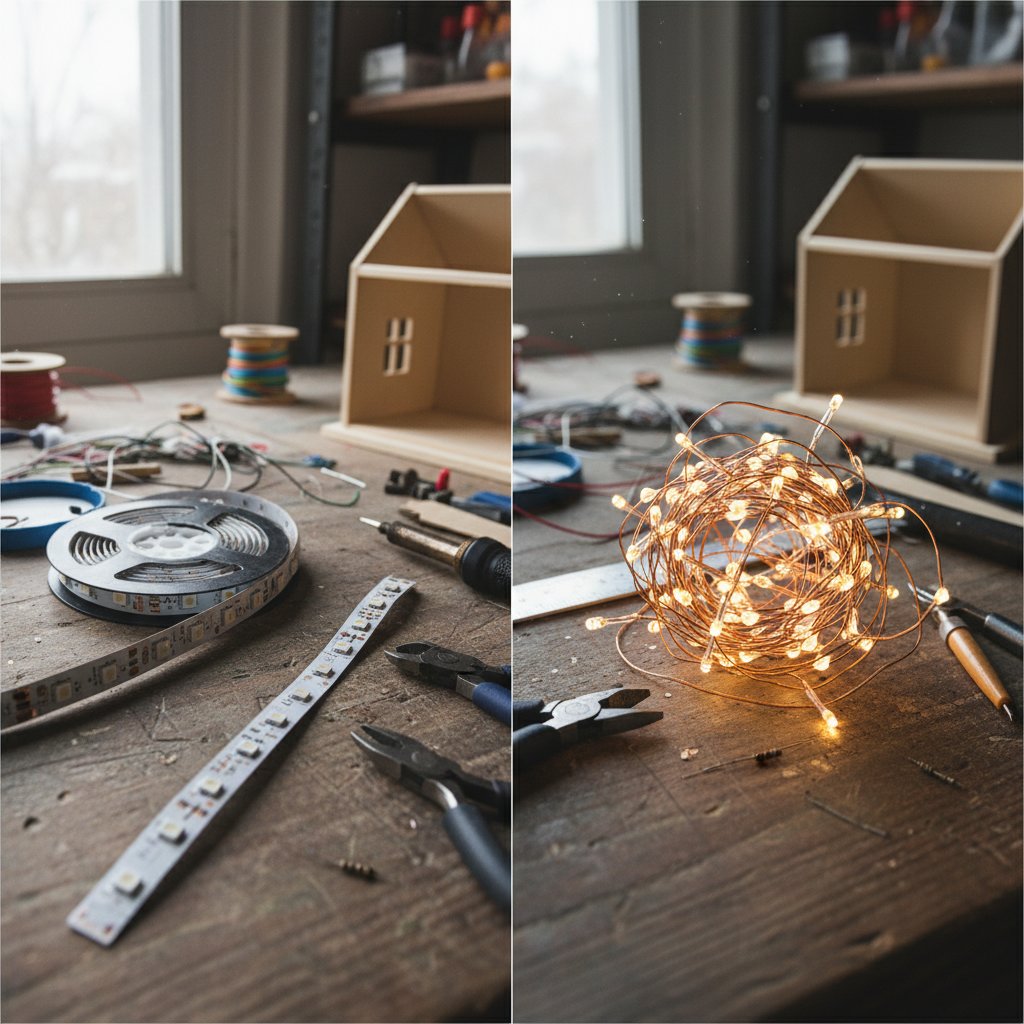
Comparison of LED strip lights and fairy lights showing adhesive backing on strips and delicate wire with tiny bulbs on fairy lights

LED Strip Lights: Pros and Cons for Shadow Boxes

LED strip lights consist of multiple small LED bulbs mounted on a flexible adhesive backing strip. They're extremely popular for shadow box projects, but come with specific advantages and limitations.

Advantages of LED strips:

Uniform, even illumination: LED strips excel at creating consistent backlighting across your entire shadow box. When positioned around the frame perimeter, they eliminate dark spots and hotspots, creating a professional, gallery-quality glow.

Customizable length: Most LED strips have cut marks every few inches where you can safely trim them to match your exact frame dimensions. An 8x8 inch frame needs approximately 32 inches of strip for perimeter placement.

Color-changing options: RGB LED strips with remote controls let you change your shadow box lighting to match seasons, holidays, or moods. Display your winter scene in cool blue, your autumn design in warm amber, or your floral project in soft pink.

Adhesive backing convenience: Quality LED strips include strong adhesive backing that sticks securely to frame backing boards or box frame interiors, simplifying installation.

Higher light output: LED strips typically provide brighter illumination than fairy lights, making them ideal for shadow boxes with many layers (10-12+) or darker cardstock colors that require more light penetration.

Disadvantages of LED strips:

Heat generation: Some LED strip lights may give off heat when lit, especially lower-quality strips or those with closely-spaced LEDs. This heat is still minimal compared to incandescent lights, but it's more than fairy lights produce.

Higher cost: Quality LED strips designed for craft projects typically cost $15-30, compared to $5-12 for fairy light strings.

Less flexible for curved designs: While LED strips bend around corners, they work best with straight edges. Curved or circular frames work better with fairy lights.

Power requirements: LED strips often require more power than fairy lights, meaning batteries drain faster. Some strips work better with plug-in power sources, limiting placement options.

Best use cases for LED strips: Choose LED strips for larger shadow boxes (11x14 inches or bigger), projects with many layers requiring strong backlighting, or when you want the cleanest, most uniform professional lighting effect.

Fairy Lights: Advantages for Paper Projects

Fairy lights (also called string lights or micro-LEDs) consist of tiny LED bulbs on thin, flexible wire. They're particularly well-suited for shadow box projects due to several unique advantages.

Advantages of fairy lights:

Minimal heat output: Fairy LED lights remain cool to the touch even after 24 hours of continuous operation. The small individual bulbs and thin wire construction prevent any heat buildup, making them the safest option for paper crafts.

Maximum flexibility: The thin wire allows you to shape and position lights exactly where needed. Weave them around frame edges, create patterns, or concentrate lighting in specific areas.

Affordable: Battery-operated fairy light strings cost $5-12 for lengths suitable for shadow box projects, making them budget-friendly for multiple projects or seasonal displays.

Twisted wire design: The thin twisted wire practically disappears against frame backing, especially in black or white frames. This creates a cleaner look with no visible light strip showing.

Battery efficiency: Fairy lights require very little power, drawing only 20 milliamps compared to 65 milliamps for incandescent bulbs. A single battery pack can power your shadow box for weeks of regular evening use.

Easy to replace: If a fairy light string fails, replacement costs just a few dollars. LED strips are harder to remove and replace once installed.

Disadvantages of fairy lights:

Less uniform lighting: Fairy lights create points of light rather than continuous illumination. This can create a lovely twinkling effect but may leave small darker areas between bulbs.

Potential for uneven distribution: Without careful placement, fairy lights can cluster in some areas and leave gaps in others, creating uneven illumination.

May require more lights for large frames: An 8x8 inch frame works well with a 6-7 foot fairy light string. Larger frames (11x14 or 12x12) may need two strings for adequate lighting.

Light penetration through thick cardstock: If you're using very thick cardstock (above 80 lb) or many layers (12+), fairy lights may not provide sufficient brightness. Some crafters add a vellum back layer to improve light transmission.

Best use cases for fairy lights: Perfect for small to medium shadow boxes (8x8, 8x10 inches), projects where you want a softer, more whimsical glow, or when working with a tight budget. Also ideal when safety is your absolute top priority, as they generate the least heat.

Making the Right Choice for Your Project

Consider these factors when deciding between LED strips and fairy lights:

Project size:

  • 8x8 or smaller: Fairy lights work beautifully
  • 8x10 or 11x14: Either option works; choose based on lighting style preference
  • 12x12 or larger: LED strips provide better coverage

Layer count and cardstock thickness:

  • 6-8 layers, medium cardstock: Fairy lights sufficient
  • 10-12+ layers or thick cardstock: LED strips provide stronger backlighting

Budget:

  • Limited budget or making multiple projects: Fairy lights
  • Single showcase project: LED strips offer premium results

Lighting style preference:

  • Soft, romantic, twinkling glow: Fairy lights
  • Clean, uniform, gallery-quality illumination: LED strips

Safety priority level:

  • Maximum safety for children's rooms or unattended operation: Fairy lights (coolest operation)
  • Standard safety with better illumination: Quality LED strips

Can you use both together? Yes! For a really fun glow, combine both LED strips around the frame perimeter and fairy lights behind the back layer. This creates layered lighting with both uniform backlighting and sparkle points. Just ensure your frame depth accommodates both light sources.

Selecting Safe, High-Quality LED Lights

Key Features to Look For

Not all LED lights are created equal. Choosing quality lights designed specifically for craft projects ensures safety, longevity, and beautiful results.

Battery-operated vs plug-in:

Battery-operated advantages: No outlet required means you can hang your shadow box anywhere. No visible cords create a cleaner display. Safer for children's rooms with no electrical plug concerns. Better for humid environments like bathrooms where electrical safety matters more.

Plug-in considerations: If you'll display your shadow box in a fixed location near an outlet and want indefinite operation without battery changes, plug-in lights can work. However, ensure they're UL-listed and designed specifically for craft projects.

For shadow boxes, battery-operated is strongly recommended for maximum safety and display flexibility.

Remote control capabilities:

Quality LED light strings include a small remote control that lets you:

  • Turn lights on and off without opening the frame
  • Adjust brightness (dimming creates softer effects and extends battery life)
  • Change colors (if RGB lights)
  • Set timer functions (some models turn off automatically after 2, 4, or 6 hours)

Remote control functionality is worth the small extra cost, saving you from dismantling your frame every time you want to change settings.

Wire gauge and durability:

Examine the wire quality before purchasing:

  • Thin, flexible copper wire (18-22 gauge for fairy lights)
  • Proper insulation with no exposed wire sections
  • Secure connections at LED bulbs with no loose soldering
  • Strong connection between wire and battery pack

Avoid lights with stiff, brittle wire that could crack inside a closed frame, or extremely thin wire that feels fragile.

Battery pack quality:

The battery pack is a common failure point in cheap lights. Look for:

  • Sturdy plastic housing that won't crack
  • Secure battery compartment door with proper closure
  • Clear polarity markings (+ and -)
  • Corrosion-resistant terminals (often brass or gold-plated)
  • On/off switch that clicks firmly rather than feeling loose

While many brands produce LED lights, certain manufacturers consistently deliver quality products suitable for paper craft projects.

Recommended fairy light brands:

Kohree LED Fairy Lights: Battery-operated fairy lights specifically marketed for crafts and DIY projects. These feature flexible copper wire, remote control with timer function, and a reputation for cool operation. Available in warm white, cool white, and multicolor options.

Oak Leaf Battery Operated String Lights: These craft-specific LED lights include 30-50 micro LEDs on thin bendable wire. They're rated specifically for paper lanterns and similar craft applications, making them ideal for shadow boxes.

LoveNite Fairy Lights: Budget-friendly option with good reviews for craft projects. Include remote control and multiple brightness settings. The wire quality isn't quite as premium as Kohree, but performance is solid for the price point.

Recommended LED strip brands:

Nexillumi LED Strip Lights: These battery-operated LED strips designed for DIY projects offer good adhesive backing, even illumination, and minimal heat generation. Available in various lengths with cuttable segments.

Lepro LED Strip Lights: Quality RGB strips with remote control and good safety ratings. The adhesive backing works well on wood and cardboard frame backing. Battery pack placement is compact and manageable.

Brilliant Evolution Wireless LED Strip: These puck-style LED lights or short strips work well for smaller shadow boxes. They're designed for closets and cabinets but adapt perfectly to shadow box use with minimal heat output.

Where to purchase:

  • Amazon: Widest selection, user reviews help identify quality products
  • Craft stores (Michaels, Hobby Lobby, JOANN): Stock craft-specific LED lights seasonally
  • Hardware stores (Home Depot, Lowe's): Good for LED strips, less selection for craft-specific fairy lights
  • Specialty online retailers: FlashingBlinkyLights.com specializes in craft lighting with detailed specifications

What to avoid: Skip dollar store or deeply discounted lights from unknown brands. These often use inferior wire, poor battery pack construction, and lack proper safety testing. The few dollars saved aren't worth the safety risk or frustration of lights failing within weeks.

Identifying Warning Signs of Low-Quality Lights

Before purchasing, inspect lights carefully for these red flags:

Warning signs to avoid:

No brand name or manufacturer information: Quality lights include manufacturer details, safety certifications, and contact information. Anonymous products offer no accountability.

Missing safety certifications: Look for UL listing, CE marking, or similar safety certifications. These indicate the product underwent electrical safety testing.

Extremely cheap pricing: If a 30-LED fairy light string costs $2 while similar products cost $8-12, there's a reason. Quality materials and proper manufacturing cost money.

Strong chemical or plastic smell: Open the package and smell the wire and battery pack. A strong chemical odor indicates poor-quality materials or manufacturing processes.

Stiff, inflexible wire: Fairy lights should have flexible wire that bends easily. Stiff wire suggests cheap materials and increased risk of wire breaks.

Loose or wobbly LED bulbs: Each LED should be firmly attached to its socket. Wiggling bulbs indicate poor soldering or connection quality.

Poorly molded battery packs: Check that the battery compartment door closes securely, the housing has no visible cracks or thin sections, and the switch operates smoothly.

No product reviews or extremely negative reviews: For online purchases, read reviews specifically mentioning craft projects, heat output, and battery life. Consistent negative reviews about overheating or rapid failure are serious red flags.

Installation Methods for Maximum Safety
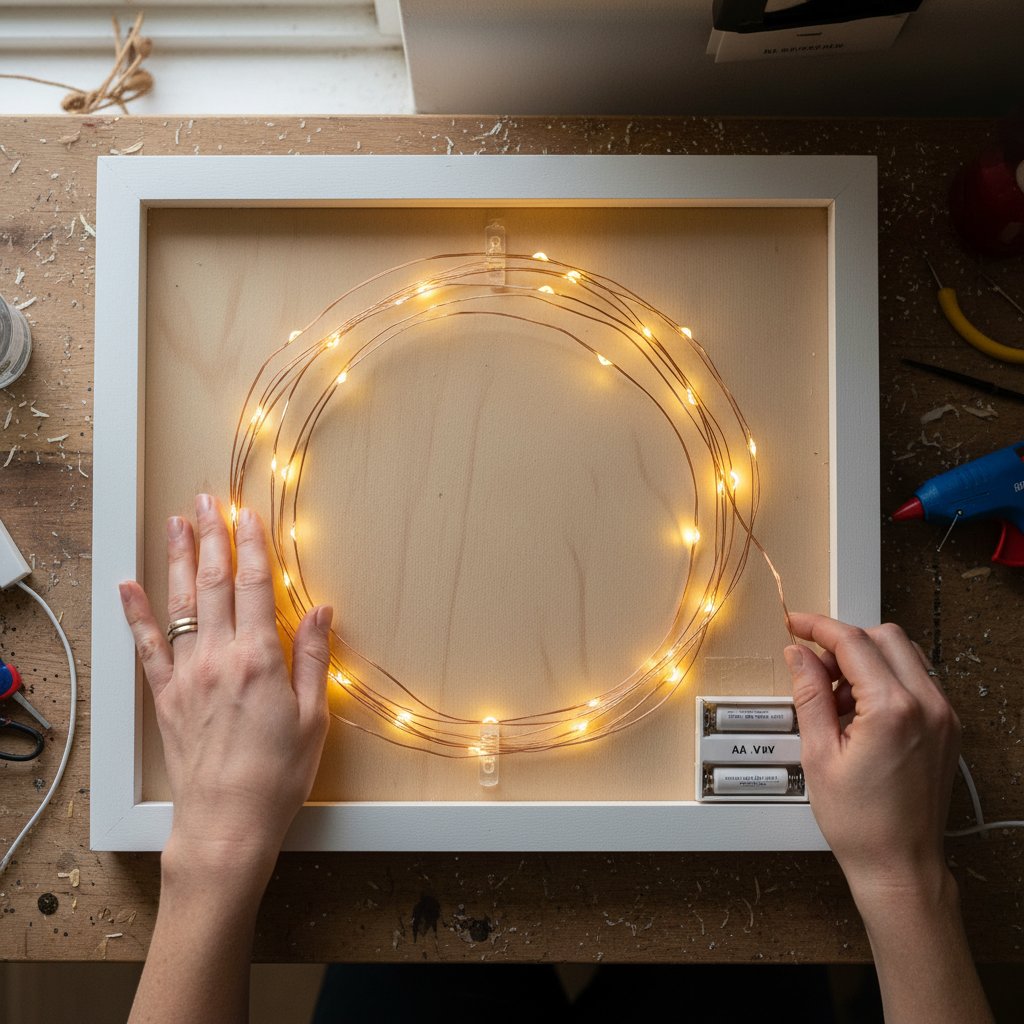
Hands installing LED fairy lights in shadow box frame showing battery pack placement and wire routing for safe installation

Preparing Your Shadow Box Frame

Proper preparation ensures your lighting installation is both safe and effective.

Frame depth verification:

Measure your frame's interior depth before purchasing lights. You need sufficient depth to accommodate:

  • Your layered paper stack
  • LED lights or fairy light wire
  • Battery pack (if placing inside frame)
  • Small air gap for minimal ventilation

Most 8-10 layer shadow boxes require 7-8cm (2.75-3 inch) frame depth. Add 1-2cm extra if you plan to install LED strip lights inside the frame, as they add thickness.

If your frame lacks sufficient depth for internal battery pack placement, you'll need to position the battery pack outside the frame, which requires a small notch in the frame backing for the wire to pass through.

Creating ventilation:

Even though LEDs generate minimal heat, some air circulation is beneficial:

Method 1 - Corner gaps: Don't seal the frame backing completely tight at all four corners. Leave tiny gaps (approximately 1-2mm) at two opposite corners. These gaps are invisible when the frame is displayed but allow air circulation.

Method 2 - Drilling small vent holes: For wooden box frames, drill 3-4 tiny holes (1/8 inch diameter) in the frame backing near corners. These provide ventilation without being visible from the front.

Method 3 - Slightly loose backing: Secure the frame backing firmly enough to hold everything in place but not so tight that it creates a completely airtight seal. Most box frame tabs or clips naturally allow minimal air movement.

Battery pack placement planning:

Decide before installation where your battery pack will live:

Inside the frame: Works if your frame has sufficient depth and you can access the on/off switch. Position the battery pack in a corner behind the back paper layer, or attach it to the frame backing with mounting tape.

Outside the frame - behind: Cut a small notch in the frame backing edge where wires exit. The battery pack attaches to the frame back with mounting tape or hangs on the wall mounting hardware. This is invisible when the shadow box is hung on the wall.

Outside the frame - bottom edge: Position the battery pack on a shelf beneath the frame if displaying on a shelf rather than wall-mounting. Run the wire out of the bottom edge.

Accessibility consideration: If your lights have no remote control, ensure you can reach the on/off switch without removing the frame from the wall or dismantling it.

Step-by-Step Installation for LED Strip Lights

Tools and materials needed:

  • LED strip lights (measured and cut to size)
  • Scissors (for cutting strip at designated cut marks)
  • Isopropyl alcohol and cloth (for cleaning adhesive surface)
  • Frame backing board
  • Assembled shadow box layers (completed before light installation)
  • Small piece of mounting tape (for battery pack)

Installation process:

Step 1: Measure and cut your LED strip

Measure the perimeter of your frame backing board. For an 8x8 inch frame, you need approximately 32 inches of LED strip.

Locate the cut marks on your LED strip (usually indicated by scissor symbols and copper contact points). Cut only at these designated points. Cutting elsewhere damages the circuit and renders the strip non-functional.

Step 2: Clean the mounting surface

Use isopropyl alcohol on a cloth to thoroughly clean the frame backing where you'll apply the LED strip. This removes dust, oils, and residue that could prevent good adhesion. Let the surface dry completely.

Step 3: Plan your strip placement

LED strips work best positioned around the perimeter, approximately 0.5-1 inch from the edges. This creates even illumination across the entire shadow box.

Decide where your strip will start and end. Common approach: Start in one corner, run along all four edges, and end in the starting corner area where the battery pack will connect.

Step 4: Apply the LED strip

Peel back 3-4 inches of the adhesive backing and position the strip at your starting point. Press firmly for 10-15 seconds.

Continue peeling and applying in sections, working slowly around the perimeter. Don't peel all the backing at once, as the strip may stick to itself or be hard to position accurately.

At corners, create smooth 90-degree turns. Don't fold or crease the strip sharply.

Step 5: Secure the battery pack

Attach the battery pack to the frame backing using mounting tape or position it to extend outside the frame through a notch in the backing.

Ensure the on/off switch and remote sensor (if applicable) are accessible.

Step 6: Test before final assembly

Turn on the lights and verify:

  • All LEDs illuminate (no dark sections)
  • Light distribution is even
  • Battery pack connections are secure
  • Remote control works (if applicable)

Let the lights run for 30 minutes and touch the strip and battery pack. They should feel barely warm or room temperature.

Step 7: Assemble shadow box into frame

With lights installed and tested on the frame backing, carefully position your assembled paper layers face-down on your work surface. Place the frame over the layers, then add the backing board (with lights attached) to complete the assembly.

Secure the backing with frame clips, tabs, or screws.

Step-by-Step Installation for Fairy Lights

Tools and materials needed:

  • Battery-operated fairy light string
  • Small pieces of clear tape or mounting dots
  • Frame backing board
  • Assembled shadow box layers
  • Scissors (if shortening wire, though this isn't recommended)

Installation process:

Step 1: Plan your light distribution

Lay your fairy light string on the frame backing to visualize the pattern. Common approaches:

Perimeter weaving: Weave the wire around the frame edges, creating approximately even distribution of light points across the perimeter.

Spiral pattern: Start in a corner and spiral inward, creating concentric patterns of lights.

Random natural distribution: Loosely position lights across the backing for an organic, random twinkling effect.

For an 8x8 inch shadow box, a 6-7 foot fairy light string (20-30 LEDs) provides good illumination.

Step 2: Secure the wire

Fairy lights need minimal securing, as the wire is lightweight and won't sag. Use small pieces of clear tape or adhesive mounting dots at strategic points:

  • Corners and edges
  • Every 3-4 inches along longer runs
  • Areas where wire might shift during handling

Don't tape over LED bulbs themselves, only the wire between bulbs.

Step 3: Position the battery pack

Place the battery pack in a corner behind where your back paper layer will go, or plan for it to extend outside the frame through a small notch in the backing.

Use a small piece of mounting tape to keep the battery pack stationary if placing it inside the frame.

Step 4: Manage excess wire

If your fairy light string is longer than needed, don't cut it (this often damages the circuit). Instead, coil excess wire loosely in a corner behind the back layer, or weave it back and forth in a discrete location.

Never tightly coil or wind excess wire, as this can create a point where heat might build up (though this is extremely unlikely with battery-operated LEDs).

Step 5: Test illumination

Turn on the lights and verify the distribution creates the effect you want. Check that:

  • Light points are reasonably well-distributed
  • No large dark areas exist
  • The battery pack stays in position
  • The on/off switch or remote control functions properly

Step 6: Place shadow box in frame

Position your assembled paper layers face-down on a clean surface. Place the frame over them, centered appropriately.

Add the backing board (with fairy lights installed), ensuring wires don't get pinched or crushed by the backing board edges.

Secure the backing with the frame's fastening system.

Managing Wire Routing and Battery Pack Access

Wire routing best practices:

Avoid pinching: When securing the frame backing, be extremely careful not to pinch or crush the LED wires between the backing and the frame edge. Crushed wires can short circuit or break.

Create wire channels: If your frame backing is thick wood, you can use a small wood file or sandpaper to create shallow grooves for wires to sit in, ensuring they lie completely flat.

Test closure before final fastening: Close the frame backing gently and check that it sits flush before tightening all clips or screws. If the backing sits unevenly, wires may be bunched or pinched.

Battery pack access solutions:

Remote control setup: If your lights include a remote control, battery pack access is less critical. You only need to open the frame when replacing batteries (typically every few months with regular use).

External battery pack: Cut a small notch in the frame backing edge (about 0.5 x 0.25 inches) where the wire exits. Position the battery pack on the frame's back, attached with mounting tape. This provides easy switch access and battery changes without dismantling the frame.

Hinged backing frames: Some box frames include hinged backing boards that swing open. These are ideal for shadow boxes, providing easy access to lights without removing the frame from the wall.

Battery replacement schedule: Mark your calendar to check batteries every 2-3 months if you use your shadow box regularly. Replace batteries when lights become noticeably dimmer, rather than waiting for complete failure.

Testing and Long-Term Maintenance

Pre-Installation Safety Testing

Never skip the testing phase. Discovering a problem after your shadow box is completely assembled and sealed in its frame is frustrating and time-consuming.

Initial out-of-box test (15 minutes):

Remove lights from packaging and install fresh batteries in the battery pack. Turn lights on and let them run for 15 minutes on a non-flammable surface like a counter or table.

After 15 minutes, touch the LED bulbs, the wire (for strips, touch multiple points along the strip), and the battery pack. Everything should feel barely warm or room temperature. If any component feels hot to touch, return the lights and choose a different brand.

Verify that all LEDs illuminate with consistent brightness. One or two dimmer LEDs in a fairy light string isn't unusual, but completely dark LEDs or entire dark sections indicate a manufacturing defect.

Extended test run (2-3 hours):

Install the lights on your frame backing as planned, but before adding your paper layers. Turn lights on and let them run for 2-3 hours in your intended display location.

This longer test ensures:

  • Adhesive backing holds properly (for LED strips)
  • Battery connections remain stable
  • No overheating occurs during extended operation
  • Remote control works from reasonable distance (if applicable)

Load test with paper layers (1 hour):

Place your assembled paper shadow box on the frame backing with lights, but don't seal the frame backing yet. Turn lights on for 1 hour.

This tests the configuration as it will actually operate, with paper layers in place. After the hour, carefully feel around the edges of the paper stack and the battery pack. Everything should remain cool.

How to Monitor Your Shadow Box Safely

First week monitoring:

During the first week after completing your shadow box, check it daily:

  • Run lights for 2-3 hours each evening
  • Touch the frame front and back after use (should feel room temperature)
  • Verify brightness remains consistent
  • Look for any signs of paper discoloration near light sources (there shouldn't be any)

If anything feels warm or looks unusual, turn off lights and investigate.

Ongoing operation guidelines:

Recommended usage patterns:

  • Turn lights on for 2-4 hours during evenings when you're home
  • Use remote control dimming to reduce brightness and extend battery life
  • Turn lights off when sleeping or away from home
  • Avoid running lights continuously for more than 6-8 hours without a break

Monthly maintenance checks:

  • Inspect battery compartment for corrosion or leakage
  • Verify all LEDs still illuminate
  • Check that adhesive backing (for strips) remains secure
  • Clean frame glass to maintain clarity

What to watch for:

Normal observations:

  • Slight dimming over weeks/months as batteries deplete (replace batteries)
  • Occasional need to press remote control multiple times (normal for IR remotes)
  • Very slight warmth at LED strip backing after hours of operation

Concerning signs that require action:

  • Any component feeling hot to touch
  • Noticeable heat buildup inside the frame
  • Flickering lights or intermittent operation (indicates loose connection)
  • Visible discoloration of paper near lights
  • Chemical smell or odor from battery pack
  • Batteries depleting in days rather than weeks

If you observe any concerning signs, turn off and unplug the lights immediately, open the frame, and inspect all components.

Battery Replacement and Troubleshooting

Battery life expectations:

Battery life varies significantly based on:

  • LED count (more LEDs = faster drain)
  • Brightness setting (dimmer = longer life)
  • Usage hours per day
  • Battery quality

Typical battery life:

  • Fairy lights (20-30 LEDs), 2-3 hours daily use: 4-6 weeks
  • LED strips (50+ LEDs), 2-3 hours daily use: 3-4 weeks
  • Continuous operation: 15-30 hours total depending on battery capacity

Battery replacement process:

Always use fresh, quality batteries from reputable brands (Duracell, Energizer, Panasonic). Cheap batteries leak more often and perform inconsistently.

If your shadow box is wall-mounted with an external battery pack, replacement is simple: open the battery compartment, remove old batteries, install new ones observing correct polarity.

For internal battery packs, you'll need to remove the frame backing, access the battery pack, replace batteries, and resecure the backing.

Tip: Set a battery replacement schedule based on your usage. Replacing batteries proactively before they fully deplete prevents the inconvenience of lights dying during display.

Common troubleshooting issues:

Lights won't turn on:

  • Check battery polarity (+ and - correct)
  • Verify batteries have charge (test in another device)
  • Inspect on/off switch, ensuring it's fully in the "on" position
  • Check wire connection to battery pack (may have come loose)

Only some LEDs illuminate:

  • For fairy lights, this may indicate a damaged LED or broken circuit; often requires light string replacement
  • For LED strips, check if the dark section is near where you cut the strip (may have cut in wrong location)

Lights flicker or operate intermittently:

  • Battery pack connections may be loose; tighten battery compartment door
  • Battery terminals may be corroded; clean with cotton swab and rubbing alcohol
  • Wire connection to battery pack may be failing; this usually requires replacement

Remote control doesn't work:

  • Replace remote control battery (usually CR2025 or similar coin cell)
  • Ensure no obstructions between remote and sensor
  • Try operating from closer distance
  • Check that sensor on battery pack is exposed and not covered

Lights dimmer than before:

  • Usually indicates battery depletion; replace batteries
  • May indicate LEDs nearing end of life (typical lifespan 25,000-50,000 hours)

Special Considerations and Advanced Techniques

Lighting Multiple Layers for Depth Effects

Advanced shadow box lighting creates dimensional effects by varying light intensity at different layer depths.

Single light source (standard approach):

Most shadow boxes use one light source (either LED strip or fairy lights) positioned behind all layers. This creates even backlighting that illuminates all layers uniformly.

Layered lighting (advanced technique):

For shadow boxes with 10+ layers or dramatic depth, you can install lights at multiple depths:

Foreground highlight: Position a few fairy light bulbs between the front layer and second layer to create highlighting on foremost elements

Midground lighting: Place lights behind layer 5 or 6 to illuminate middle layers

Background lighting: Install your main light source behind all layers as usual

This technique requires careful planning and sufficient frame depth (minimum 10cm/4 inches). Use extremely minimal lighting at front layers to avoid overwhelming the effect.

Color layering:

If using RGB lights, you can create dramatic effects by changing colors for different moods:

  • Warm white or amber for cozy, traditional looks
  • Cool white or blue for winter, modern, or night scenes
  • Green for nature themes
  • Red or pink for romantic or holiday designs
  • Slow color fade modes for dynamic, changing displays

Lighting for Different Frame Sizes

Small frames (5x7, 6x6 inches):

These compact shadow boxes need minimal lighting. A single 6-foot fairy light string (15-20 LEDs) provides adequate illumination.

Consider using individual battery-operated LED puck lights rather than strips or fairy lights for very small frames. Position one or two pucks behind the frame backing.

Medium frames (8x8, 8x10 inches):

The sweet spot for shadow box projects. Both fairy lights (20-30 LEDs) and LED strips work well.

For LED strips, you'll need approximately 30-35 inches for perimeter placement.

Large frames (11x14, 12x12 inches and up):

Larger frames benefit from LED strips for even illumination. Alternatively, use two fairy light strings positioned to cover different frame areas (one for left/top, one for right/bottom).

For frames larger than 16x20 inches, consider professional LED panel backlighting or multiple LED strips to ensure even illumination without dark spots.

Seasonal and Themed Lighting Ideas

Christmas shadow boxes:

Use warm white lights for traditional Christmas scenes. RGB lights let you alternate between traditional warm white, festive red and green, or elegant blue and white.

Add a slow twinkle or fade mode (if your lights offer it) for magical Christmas atmosphere.

Halloween shadow boxes:

Orange LED lights create perfect spooky ambiance for Halloween scenes. Many RGB LED strips include orange color options.

Alternatively, use flickering LED modes (if available) to simulate candlelight for haunted house designs.

Wedding and anniversary shadow boxes:

Soft warm white or pink lighting creates romantic effects for wedding memorabilia shadow boxes.

Keep lighting subtle and elegant rather than bright and dramatic.

Nature and botanical shadow boxes:

Green-tinted lighting enhances forest and plant themes, though natural warm white works beautifully for most botanical designs.

Year-round versatile shadow boxes:

For shadow boxes you'll display continuously rather than seasonally, choose neutral warm white or cool white lighting that complements your home's decor style.

Conclusion

Adding LED fairy lights to your paper cut shadow box safely combines beautiful illumination with proper safety practices. By understanding the minimal heat output of quality LEDs, choosing between LED strips and fairy lights based on your project needs, selecting high-quality lights designed for craft projects, and installing them with proper ventilation and testing, you create stunning light-up paper cut shadow boxes that glow safely for years.

Whether you choose the even, uniform illumination of LED strips or the whimsical twinkling of fairy lights, following the installation techniques and safety guidelines in this guide ensures your shadow box is both beautiful and safe. Test your lights thoroughly before final assembly, monitor your shadow box during its first week of operation, maintain batteries regularly, and follow recommended usage patterns for long-lasting, worry-free enjoyment.

Your illuminated paper cut shadow box represents hours of careful cutting, assembly, and design work. Lighting it safely preserves that work while creating the magical glow that makes shadow boxes truly special. With the right lights, proper installation, and ongoing maintenance, your shadow box will shine as a beautiful focal point in your home, combining craftsmanship, creativity, and safe illumination into one stunning display.